
Stoving oven
Heat cure using the planned in-house oven; verify the actual temperature profile using a data logger.
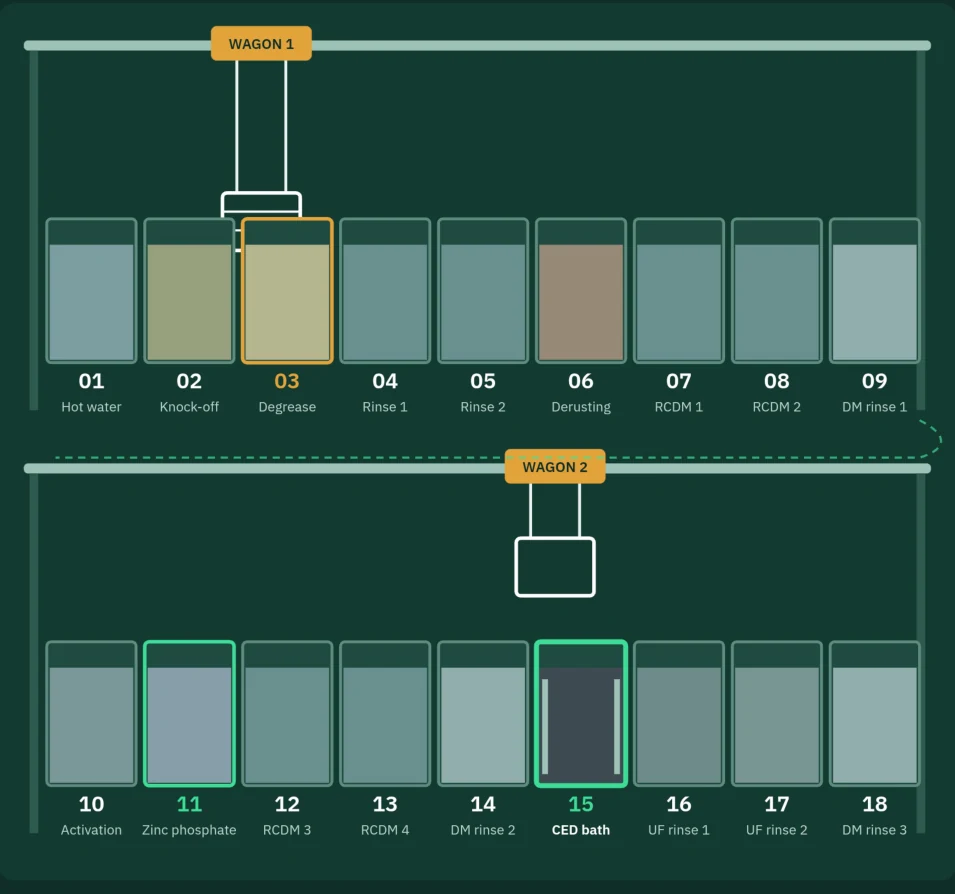
THE EXACT PLANNED TANK SEQUENCE
Each tank is specified at 2,500 × 1,250 × 1,250 mm. Two transporter wagons, each rated to lift 1,500 kg, are planned to execute recipe-controlled dip and drain cycles.
Remove oil, scale and rust
Rinsing, activation and zinc phosphate
CED deposition and rinse recovery
BROCHURE ILLUSTRATION
Artist's illustration of the planned facility. Actual equipment will be verified during commissioning.
AFTER TANK 18
The proposed sequence continues from the tank line to heat curing and checks before dispatch, with powder or liquid top coat added when specified.
Heat cure using the planned in-house oven; verify the actual temperature profile using a data logger.
Check dry film thickness, adhesion, cure, corrosion testing and bath/process parameters as applicable.
Apply the specified finishing system where the application requires additional appearance or performance.
Steps 19–21 describe activities following the brochure's 18 numbered tanks; they are not additional process tanks.
PROCESS-CONTROL SYSTEMS
250 V / 350 A rectifier, eight tubular anode cells
5 TR air-cooled chiller
Eight pumps and eight bag filters
Closed-loop ultrafiltration and automatic cascading rinses
Two oil skimmers and four temperature-controlled heated stages
Filter press with 24 plates, each 18 × 18 inches
TAKE THE NEXT STEP
Share dimensions, coating specifications and monthly volume. We will discuss the process, jigging and commercial requirements.